A question come to my attention that hangs up the beginner and newer students to music.
I observed the question even with my daughter who has been playing for a couple of years. It has to do with how sharp and flat symbols are used in the staff lines and between measures.
We cover the note symbols in the notes lesson at music theory sharps and flats. However, there is a basic issue with understanding the use of these symbols that create problems for the beginning student.
There are 3 items that I want to cover in that the musician must understand in order to play the correct notes shown on sheet music.
First Rule – Key Signature Sharps or Flats
The key signature defines all the sharps and flats that are used in the song. These sharps or flats will be used for all these notes. They will be consistent through out the song.
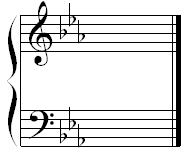 Here is an example of 3 flats at the beginning of the song. For the notes that show up anywhere in the song ( B, E, and A) they will always be played as a B flat (Bb), E flat (Eb), and A flat (Ab). That is unless modified within the song by a natural sign or a sharp sign.
Therefore you will always play the key signature as shown. This becomes second nature when you fully understand the key signature and scales.
Second Rule of Applied Sharps and Flat Symbols
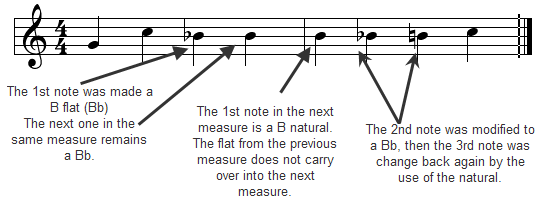
When a note has been modified by a sharp or flat symbol, it will last for all of that measure, but only for that measure. It changes back to a natural note or the original key signature note when moving into the next measure.
Remember that another symbol can modify it again. This picture shows this concept so you can see the changes that are typical when they take place.
Third Rule About Notation Of Note Symbols
When lots of sharps and flats are used you may find that it's hard to follow the music and the note changes. Often times you will see that every chord change will show the sharp, flat, or natural symbol to make it a bit easier to read.
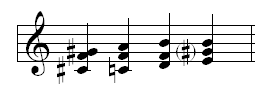 Often times you will see a symbol like this (#) or (b) before the note reminding you that the note is a sharp or flat when there are a lot of modifiers in the measure of music.
Hope that helps to clear up the confusion. If not post a comment and I'll try and explain more.

that was really helpful for a beginner like me. The 2nd rule especially. =P
Thanks
Stefanos, I glad that helped you clear up the application of incidental sharp and flat symbols.
One thing I should clarify on rule #2 is that if the note is tied across the bar line it retains the previous note modifier and then will apply to the rest of the measure.
Sometimes, There are always these little things that those of us that have played for awhile forget that the beginners have not experienced and it can through them off.
Stay with it, and stay tuned.
in the 2nd rule after the natural, do u play the note flat?
Stefanos, I might have revised the sentence to say “…. modified by a sharp, flat, or natural symbol, it will last for all of that measure,
So anytime a symbol changes the note lasts until the end of the measure or until another modifier changes it. So once the natural as been used it will continue to be a natural for the rest of the measure.
It would only be changed to a flat in the next measure if: 1. The key signature has that note as a flat, or
2. if it is modified by the flat symbol.
As you can see from the example the last note of the first measure was flat, but the 1st note in the second measure start at natural, then went flat, and then back to natural. If there was another b it would say natural.
Hope that helps.
what really is sharp or flat key
notes?
can you tell me how to read symbols?
Reading symbols is about learning what notes mean and the modifiers that go with them. Notes represent two things a pitch and a time value. It takes a little time to work through the specifics and our notes workshop goes into a lot of detail on how to do that from basic notes, master staff, and intervals. You can learn the basic principles with two of the lessons in the main site at:
music-theory-notes
the continued second lesson covers sharps and flats. In it’s simplist form a sharp is one half step up from the base note and a flat is one half step down from the base note.
and
Note Symbols
goes into what each note symbolizes.
I was never sure if the flat or sharp signiture carried from measure to measure or until it
was “relieved” by a natural and returned to the original signature.You have clarrified it
for me. Thanks
Glad to help Bob, this is always tricky one, sometimes the author of piece may forget to add or correct. Happened to me on a Mozart piece, you never know if it was suppose to be a F natural or an F sharp. Sometimes it sounds good both ways. Artist interpretation!
hi Bob! if a measure (from the grand staff) introduces an accidental mark (say a flat sign on pitch F at the bottom measure), must the sign be applied to the upper measure when I see the note F( even though the sign is not there?)
This is an excellent question Esther. One can be easily confused by the addition of the flat or sharp in one clef but not the other. In almost every case the introduction of the accidental in one clef will not effect the other clef. Both clefs would show the change if it were to meant to applied to both notes.
However, the notation may not always be correct as shown and you should audition the notes to make sure that it works. Think jazz chords here.
In jazz it is very common to add a flat or sharp in one hand and not the other. Some of this may be attributed to enharmonic spellings of chord notes. Some times you may be adding in sharp 11ths or 9ths to add color to your chord and you can end up with the natural in one clef and the sharp or flat in the other.
Hope that helps.
Thanks Brad! That clarified it for me really well.
hehe, Sorry for getting your name wrong. ^^
Very very helpful. Im writing a song for music class and everyone around me is talking about accidentals, naturals sharps and flats and how they affect the key sig. etc. thanks. it has really widened my palette of musical knowledge
Sab, Glad to be of help. Sometimes it can be the little things that hang us up. Making sure you know how it works makes it all that easier. Best of luck, hope you have a great time composing.
Thank you! This helped a lot, I was getting really confused when reading music because I didn’t understand this, but now I do 😀
Thank you so much! I learned a lot because of this article. 🙂
I’m about to start my keyboarding lessons and I was a little nervous so I researched some basic tips and I am so glad I found this website!
Hannah,
You’ll find lots of valuable information here to help you with your theory study. I hope it makes your journey easier.
Another clarification if will indulge me. In a single line score for flute for ex. will the modification of a note hold for only that register, or for all octaves throughout the measure? As in the case of a 2-1/2 octave run.
Doug this is a great question, but also an answers with exceptions. In strict theory the run would use the modification for all subsequent notes in other registers within a single measure, but not into the next measure.
In practice, it is always best to show the modification on the other registers for clarity of intent. If you were to stay true to a scale or scale modification it would hold true throughout the run. An example is that you may be in the key of C and change the notes typically played on a D minor chord (Dorian mode scale) into a D Major Scale or Chord then the F# and/or C# would be expected for all runs into the next register.
In some music, especially jazz, however, enharmonic notation may actually not have the sharp or flat apply to other notes. Usually in these cases the natural sign will be used to indicate the desired note.
I’ve had this situation occur with a Mozart piece I was learning. I ended up auditioning it in both situations, funny thing was I could make it work for me either way as an expression of the music. Playing it both ways will usually give you a sense of which note you should use in the context of the phrasing.
In some cases you may find many modifications, often with chords runs on chromatic scales. In these cases it will depend on your understanding of the chord progression intention and the modifications may only apply beat by beat. (This is usually an extreme case, but be aware it does happen)
I know I ran you around the horn on this one, so in general the modification should hold true for the measure or notation line throughout the run. However, know that it doesn’t always hold true based on who produced the notation or the intention of the artist. I typically assume it is true unless I have reason to believe otherwise.
I hope that helps.
I just started and was reading the lesson book that says ” a sharp carries thru the whole measure.” So if there is a sharp at the biginning of a measure, and this measure consists of 4 different notes, then still every notes is a sharp? For example, a measure starts with a sharp, and has 4 notes on the base cleff, G, B, A, G. Do I play #G, C, #A, #G?
Also, what about if a measue starts with a sharp, and consists notes on Base Cleff and Treble Cleff? For example, G(base), B(base), E(Treble), G(base), Do I play #G, C, F, #G?
I am a new learner just feel so hard to figure out. Thanks!
Dealing with sharps and flats is one of the harder points to grasp when learning music. This comes from the fact that the composer may not always make it clear when scoring the music. As the teachers and composers take liberties with accidentals (local sharps, flats, naturals) and you some times have to audition the music to determine what the intent might be.
As I’ve stated before, I read the sheet music based a set of basic rules first. These questions are not easily explained in text, so I’m going to write a new post with visual examples this week to address these questions. In the mean time here are a couple guidelines to help you along the way.
1. Looking at the key signature, say A major there are 3 sharps defined that apply to the entire song on every measure they are F#, C# G#. No matter where you are in the song they always apply unless specifically changed in a measure.
2. When a sharp or flat is applied on one line or space it is only applied to that one note not all notes the chord. In the case of G, B, A, G if the sharp is applied to the G then you will only play G#, B, A, G#. In a proper case you will see that # applied on both notes. In Jazz it might be common to see it applied to only one note and you would play G#, B, A, G. Where the second G is a natural.
My rule for notation is that the sharp or flat is only applied to the line that it is shown on, as in the second example. Unless of course I audition it and find it fits better if I add the next sharp. (I will then write it in if I feel it should be sharped)
3. If a sharp were to be applied in the Bass clef it would not be applied in the treble clef, and visa-versa. So in your second example if the # were applied to the G in the bass, it only applies to that G and no other notes. If the composers wants you to apply it to other notes it will clearly be shown in both clefs.
Start with these two rules:
Key signatures apply sharps and flats across all measures all the time, until overridden at an individual measure.
The sharp or flat when applied at individual measures applies to only the note line/space that it is shown on for only that measure.
Play notes as shown, don’t assume that a sharp or flat applies to any octave note unless shown.
Only modify other notes if you believe that the other notes sound better when playing, but be aware that that odd sound may be what the composer was going for in the phrasing. Think jazz.
I was pretty stuck on this topic untill i read this, the second section was the part that was killing me, thanks alot
Hey is it possible not to have any of the flat or sharp symbols on the music sheet but to play some notes still in sharp? I am new at piano. Help me. I recently gotten a keyboard with book. In some music part keyboard exercise tell me to play some notes in sharp even though there isn’t flat notes or sharp notes on its book. Please Give me some advice. Thank very much
Josh,
In reading music the sharps or flats are indicated in one of two ways. First as you have indicated they would be right next to the notes you are asked to play. In the second it is done with the key signature which is shown only at the first of the staff lines next to the clefs (left hand side). In this case you will not see the individual notes with sharp or flat symbols next to them, but will be implied throughout the song.
In many fake sheets they will only show the notes on the first line at the very start of the song and each additional line is considered a continuation of the this line. I personally don’t like this method as you can change keys in a song and it can get confusing if you don’t have that little reminder.
Without actually seeing what you are playing it’s hard to see what they are trying to teach you. There are cases where they are trying to teach you how to think in a key without seeing the written key signature. This is a good thing, as it is teaching you to really understand key signatures and scales. The unintended problem is that it adds to the confusion of learning if you having got those concepts down cold.
Hope that helps.
how do I know where to place a major or flat?
Susan, Not sure what you’re asking, Placing a major doesn’t make since. I’d need more context for placing a flat. Kind of need to know what you’re doing.
i am good with the piano but i want to know how to place my fingers when playing songs
I want to know the best way to place my fingers when playing songs on the piano
This is a great question Okitakpe! However, there is not exact answer. Playing scales we learn placement as is detailed in the Scale keyboard Fingerings Workbook. Correct fingering is the ability to flow smoothly between notes or between passages, so you have to experiment or audition your fingering to make it smooth for you.
I’ve often taken a given fingering and changed to fit more of my style. After so many years you tend to figure out what works without thinking about. I still, however, find myself working through some fingerings to make a passage flow into the next.
im 11 and in 6th grade band. were just learning this and i want to know what difference does it make with the key sinature bc all the notes in the song are the same with flats and so why do u need the key signature when u no all the notes are flat.?? will the whole songs tmpo and sounding change or will it stay the same.Plz answer quick i got a concert coming up tnxxx!!!!!!!!!!!!!
Shriya, if knowing all notes are flat is what it takes, that will work. Learning a key signature is about learning new songs and which notes will be part of that songs structure. If you are reading note by note to play it works, I just think that it takes a long time to master music that way. If you know the note intervals of a song you can transpose it to any other key; maybe they are all not just flat. Different key signatures each have a slightly different sound to them. That’s why you will hear musicians talk about how an A major sounds different than a A flat major. Without knowing your exact situation it’s difficult to be able to encourage learning a key signature if all you have to do is play the notes flat. I might look at it this way if you are playing in the key of C and I said now let’s play those note changes in the key of F, you’d have to know what notes are in the key of F and translate what you played in C to F.
Anyway at this point you need to work on performance and play the notes the way you know them. Best of luck.
Brad_C; I have been reading your very helpful notes and comments. I play classical guitar and one thing has always confused me. If the note is modified (accidental) within the measure, does the modification apply to the same note in a different octave? Can you tell me the convention for this? It seems to me logically it should unless specifically written otherwise. Thank you very much for your help. Dan
The confusion of the accidental is in the presumed application. The smart author would show it in both locations to eliminate the confusion. If a sharp or flat is shown and then you are playing an octave above where it is not, I’d likely assume that it doesn’t apply. That is because in jazz style of creating chords it may be an enharmonic note that is being used to create a specific chord voicing where both notes may be used.
In melody line, it would not be unreasonable to believe it applies to the next octave, but it may or may not be true.
I’m going to suggest that you try to use your ear to audition the two notes and determine which fits the situation. Although it may not be easy it is about the only way you can determine if it applies. Unfortunately, it may not always be clear, I’ve dealt with a Mozart piece where either note would fit, then it had to become the artists choice as to which one you would play.
My rule is not to presume it applies to the next octave unless it doesn’t sound right to me. That is only based on experience and your ear. Hope that helps you make some determination.
Thank you so much for this information. This is very much appropriated. It cleared up my confusion. Working on a music book on my own, and I didn’t quite understand the Sharp symbles and where they applied, even tho I knew what they were. Once again, thank you very much.
This was always one of those things that trips up a lot of people. Howerver, once you get it it, it just seems natural. Oh, pun intended, yeah! Best
Brad
Ahh thank you so much! The second rule was what i was struggling with, thank you so much for helping to clear that up! 🙂
Hello.
I have a question regarding flats and sharps. You said that when you add a sharp to a note it affects all that same note in that measure. But would it affect the octave of that same note if they are within the same measure?
Hey Evy,
In true theory, yes you would expect it to apply to any same note after that in the same measure. That said be warned, that not all musicians understand this and do not apply it that way. I’ve more often seen both notes get the sharp or if it where not to be changed you’d see both a sharp and a natural shown for clarity.
With the jazz transcriptions you have to be more concerned as often this group likes to apply it “at the moment” so that it only applies for that note.
If the octave is on the same beat, the interpretation is exactly as shown, so you may have only one note with a sharp, you’d play the other with the natural.
I’d say apply it to the following notes unless it doesn’t make sense in the application. Audition the sounds to make sure you are hearing what you believe you should hear.
Sorry, not everyone plays by the same rules. Use your best judgement and your ear.
Best of luck.
ok, what if there’s a 2 # D major key signature… in this case you’ll have F# and C# instead of F and C, right?
And you have in the Bass Clef a note just under the lower line… with a b….
Is that reverts your F# to F or takes you right to Fb? Cos I use http://www.musictheory.net exercises to practice and it says it’s an F flat (Fb) note… My logic dictates that my F# is being moved a half step down, and it should be F. On the other hand… it could be that a natural sign should be used to move the F# back to F and if there’s a b, then it goes straight to Fb.
One though though, I think the whole question is for the exercise’s sake only, cos I doubt there will be a sheet music where one would see such an occurence of b’s and #’s…
Thanks,
DanZi
DanZi,
Correct D major has two sharps, F# & C#.
At the bottom of the bass clef is F with the flat symbol it would be read as a Fb .
F# an half step down is a natural F, Fb is one more half step down same as (E). So yes natural sign is used to chage it back to F.
If you would want the note to be Fb then you label it so. It is not necessary to use the natural then apply the flat symbol.
Jazz is the most likely place to see both sharps and flats together, often as enharmonic call outs for construction of extended chords.
if a natural sign appears in front of a sharp or fat note what would happen (flutist)
A natural sign appears before a sharp or flat to bring that note back to natural before applying the notation again.
That is if a note such as Ab had a natural sign then a sharp sign then it is indicating that the normal Ab is now a A#. This most often happens when the key signature has sharps or flats and the composer wants to make it something different than in the key signature.
This is just a mechanical way of showing the change completely. If the natural sign was not there it is likely you would see the note as show, such as the A#. It technically could be read as making the Ab sharp which would be played as a natural A. This is a subtle difference that is way the natural sign is used.
If there was a sharp on middle C for example, when the next C up (third space for treble clef)– if it occurred again in the same measure–also be sharp?
There are two camps on this one. In the classical camp the typical answer may be yes, if you change middle C to sharp you would assume that the other C’s would also become sharp. This is not always consistent.
HOWEVER, in the jazz world I’ve seen it applied only for that specific note.
My recent experience with notation software takes this second approach. Any modification is only for that note on that line or space.
If I were to write that score out I would actually show every additional (different) C note with the sharp, if that was my intent. I may also show it as natural with the () to indicate my true intent, so we don’t have this confusion.
Again I caution that you if you are reading a score that you need to audition the notes in context and see if it is producing the sound you expect. I’ve just recently run across this very type of notation and had to audition the sequence several times before I decided what I was going to use.
One other thing is that if you have a chromatic run expect that every note will be as notated to provided clarity, but if the run goes up and down the second part may not provide the notation. Study it and take the tact of always providing clarity when you write it and expect the same of the author.
Thanks for the information, especially on sharps and flats. Very clear and concise. I’m learning Memphis Stomp and needed help.
thank you, this was extremely helpful
Hi. Would you actually play a D natural in the key of D if you come across a C note marked with a sharp? In other words, I see a C. It has a # in front, which is not at all a courtesy #. I am in a key where the C is already played as a C#. Do I play the D? It is Isaac Albenz… you know those crazy impressionists!
Thanks,
Brad
@Brad,
The annotation of a note is an exact reference and not an additive one.
That is if it is a sharp before the note that is the exact indication that it is a C sharp. Althought the key of D has a C# in the scale, the indication of a sharp is to counter another modification or a precieved modification of the C note. It may have been natural in a previous measure and the author is now indicating that it is back to the C sharp expected. It would need to have an x in front to indicate a double sharp to be played as a D natural.
Remember that the modifier is telling you what it is right now.
I am thinking about playing Hungarian Dances No. 5 , and noticed that it was in an unfamiliar key_ (includes G sharp, F sharp, and C sharp_) what my question is, is that if there is a G sharp whats the fingering? Because i dont generally understand it because l the other notes are differant fingered then normal. Please get back to me as soon as possible thanks_
Zoe, the key is A with the sharps of F, C, G. If you’re trying to figure out a specific instrument other than piano you will need to refer to that instruments fingering chart on how to play these specific notes.
Fingering on the piano for the A scale puts the 3rd and 4th fingers on F# and G# and you will play the C# with the 3rd finger. Otherwise fingering of any specific riff or run of notes is dependent upon the phrase and what is being achieved. I have often ended up changing a given fingering because I found a better flow of the notes that what was suggested by the editor. Try different approaches with a focus on where the notes are going.
Why not mark sharps and flats? I know your supposed to remember them from the key signatures But, I can’t!!! (And I been tryin’ for 66 years! Call me dumb!
Look, why not argue that its a waste of time to capitalize the first word in a sentence, since we all know they are Capital cause they are the first word in a sentence? Same thing. Did this come about because of lazy scribes? Well, now machines do it.
@bob, The intent was to clean up music so that it was actually easier to read. Therefore it’s a matter of knowing your key signatures and scales. I too struggled with this until I understood the theory and application behind it. Once I knew the “key” I also knew the sharps or flats. Yes, I agree if you’re only reading notes you’ll always have trouble remembering which ones are sharp or flat. Not sure your analogy holds water. Could we not also say bar lines are the capitol of the measure, therefore we can get rid of them. Cues like these are there to help us read and organize better.
Don’t get me wrong I’ve had times where I’ve written all the accidentals so I would remember, but with better understanding of keys and scale notes it’s gotten easier and easier, especially with improvising.
Thanks so much for the helpful explanation! I am trying to learn piano and that (second rule of applied sharps and flats) is exactly what I was looking for. Thanks for taking posting this.
Do you carry out the sharps/flats for all the following notes in the measure or just ones that are the same note as the one with the symbol originally?
Robbie,
If I understand your question correctly it’s about the possibility of playing an indicated sharp/flat of the same note in a different register that hasn’t been clearly indicated.
Typically, there would be clarity in that both notes would be indicated as sharp or given a natural sign if not, however, this is not always the case. I first take the approach that it’s only the note shown that gets the #/b thru the rest of the measure, then I audition the notes to see if it sounds as one might expect. If not, then I apply the #/b and audition again.
In jazz it’s very common to only #/b the note at hand. The problem with our hard and fast rules is that they are not hard and fast for everyone. Experiment and listen this is the only way you can be sure. In my composition I will try to make it as clear as possible and this is what I encourage for all composers.
I’ve been looking, but have not seen the answer to my question on this site. I would like to know if a note has a sharp sign in front of it in one measure and the note is tied to the next measure, does the note stay sharp? It doesn’t have a natural sign in front of the tied note so do I continue holding it as a sharp? Thanks in advance for your answer.
Tracy,
A tied note was one I didn’t cover, but is easily considered.
A tied note implies that the note is held, therefore it will be the same note and will be sharp. If the line is a slur it would be a half step down.
By extension, if this note is played again in the measure after the tie it will be sharp unless notated otherwise for the rest of the measure.
As with any notation the author may make assumptions and could notate with a (#) in front of the note to remind you it is sharp. Otherwise you would see a natural sign in front of the note. In the case of the slur the author most likely would indicate it as a natural to avoid the confusion.
Sharp or flat the rule applies.
I am learning to play guitar by notes, that is I use regular hymn sheet music and have learned the three Key Major scales, C,G&D so far, I have two questions,
1. Why different scales, ex. C has no # and goes from low C to E then up to G then back down to C, but the Key of G Major runs from low G to E then up to High G and back down to C with F#, and the Key of D Major runs from low D down to E then up to G and back down to C. with F# and C#s
Why do we learn this as different patterns for each scale, seems all we need to know is the sharps or am I missing something?
2. Why does some music have # or b indicated in the signature when not one note is, example, Key of G Major, but not one F note in the piece, or example, Amazing Grace is in b flat, yet there is not B note in the hymn?
Thank you
God bless
Jim
Jim,
I’m having a little difficulty following your fist question as you are describing chord notes for the key of C and the rest seem to be different note patterns sequences.
All I can say is that scales have basic patterns of half or whole steps that do not change. See my page at:
http://www.musiclearningworkshop.com/music-theory-scales.html for further details. and
http://www.musiclearningworkshop.com/basic-music-theory-elements.html for other basics.
Essentially at each new note you start on as you go up a fifth a new sharp is added based on the pattern for a major scale.
In number 2, the song may not use all the notes of a scale and often they use only 3 or 4. in G and F# may not get played in the melody, but is likely to be added in the underlying chord structure to support the harmonics of the song. If a key signature is Bb and there is no Bb played it may be composed in the minor key a third down (G minor) thus the use of the Bb as a third of the key may not have been used.
There are any number of other reasons, but that’s what I’ve got for you based on the information you provided.
So if a piece of music has a note that is already flat according to the treble cleft and there is a flat next to it in a measure, it’s simply reminding you that it is flat again or is it like another flat?
I would have to see the context to ensure I understand your statement. Usually when you see bracketed flat such as this (b), it is a reminder that it is still flat, possibly due to a previous measure change. If it is just the flat symbol then it is returning that note to flat from a previous change within the measure. That is if this note was made natural previously within the same measure at a different octave, then the author is resetting the note back to flat. Say that a B flat in the bass clef was changed to a B natural, then the B in the treble clef may indicate the flat to ensure the author didn’t want the treble clef note to be natural.
THANKS TO BRAD I GOT VERY CLEAR IDEAS ABOUT MANY QUESTIONS WHERE IN MY MIND TO ASK ABOUT.I’M VERY GRATEFUL TO BRAD AND I’D LIKE TO ASK IF HE CAN SEND ME A SCHEDULE OF MAJORS THAT WILL GIVE ALL SHARPS AND FLATS IN MUSIC.
You can find many giveaway pictures or key signatures by searching around. I, however, promote learning them all the right way and that is why I offer the workshop on keys and scales so you can do just that. Check it out here:
Brad
Brad.
Thanks. I enjoy reading your measured and very thoughtful comments. This question/complaint may already be addressed, but I don’t believe so. I’d enjoy hearing your opinion.
I started taking music lessons from my mother about 71 years ago. For that entire period, I’ve detested the concept of every letter-key, A through G, having a different key pattern than every other. Some minds obviously deal with it well. Others cannot. I’d like to see a responsible survey of persons who stopped studying music because a teacher pushed 5-sharps at him or her. Or 6-flats. I quit and walked from formal interest in that type of piano study. I new how to play in C, and F, G, maybe. I didn’t need those other keys.I was the church pianist at more than one church, with my “limitations”. The music group of the various churches knew my limitations. I cannot justify those “complicated” keys. If someone wants to write them — fine. We’ll just thumb by them in the book.I fear that a lot of people were shut out of music development because an over-sophisticated group of writers wished to show how complicated they could write music. Can you make a statement that could justify for me why someone would
write music in the key of D-flat? rather than in the key of C Thank you.
Arden Warner
Electra TX
Hey Arden,
An interesting concept about forcing a large number of sharps or flats on the student in the learning process. In the traditional method the approach taken to adding more sharps and flats can be daunting for sure.
For me I learned the mathematics of music and the patterns associated with a large number of flats and sharps and never found learning or playing in them all that difficult or complicated. You see I understood the key signature, scales, notes and chord patterns and thus harmonic system as a whole; primarily because I learned music as a language and not a note by note reading system.
To answer your direct question of justifying writing or playing in those other keys: Because music is a tempered set of notes and not perfectly harmonic the sound of a song played in one key will actually sound different in another key. I usually ask folks to try a simple chord progression in two different keys to see if they can hear the difference. It won’t be great but a good ear will hear it. I experienced a case where I played a song from Nora Jones’ first album I had translated it from 5 flats down a half step to get to C major. After playing a few phrases in each key I went back to the flats as it sounded more rich to me in the Db key. So that reason is the preference of the tone or sound you are getting.
Another argument is that of the singer. If you watch The Voice or American Idol you’ll hear them talk about about changing the key to make the song easier to sing or to give it more character to fit the singers range or vocal ability. Often times this is just a half step to a sharp or flat key, but it can be a whole step or more. The song written in C could easily be Db, D or Eb.
As a matter of my journey, I gravitated toward the key of Eb with 3 flats as a favorite key. I then often improvise in Cm (3 flats) with an interlude to the key of Eb then Db or Ab. So I like the ability to use these variations in keys to get a slightly different sound or feeling. This may not be the case for you as music in the end is a personal preference.
Don’t know if that will justify it for you, but it’s really a matter of attitude towards playing music, you get to make the final choice as to whether it’s something you wish to deal with or not.
Best of luck.
Very well done response.I don’t know why I’ve never been persuaded. I used to have similar views. Particularly when accompanying singers. I’ve wondered if there is a rule of thumb, that implies how “high” and how “low” a piece of music should be written. It appears to be an insurmountable problem for me. I’ve learned to live with it. For many years I remember hearing Marian McPartland contend that a particular piece, that she so liked, sounded better in a key with several sharps and/or flats. than the more “neutral” key it was written in. She was no doubt right. But I couldn’t hear it. I’ll acknowledge that I’m unschooled. And now, at my advancing age, I have a questionable “ear”.
My wife insists upon a high-dollar wine. I can survive happily with a box-wine from a discount store. My friend insists upon having the fancy liquor with the candle wax around the top part of the bottle. Personally, pour two samples in separate containers, and I will not be able to identify the high-dollar offering from the low-dollar offering.
I don’t know the history of the piano well at all. But I’d very much like to have been on the scene when the craftsmen were deciding the arrangement of the seven white notes, and five black notes. I have relatively small hands, and have wished — forever — I could span a “tenth” without “rolling”. Had I been there when they decided how they’d do it, I’d have designed a keyboard with six and six — black and white. There are many ways to replace the “ques” to alert where C is located. Would we have had a different C-toC sound that we accept as readily as we now accept a C-to-C scale on The seven white notes that the current arrangement accepts as “right”. With two half notes inserted?
Maybe someday, with a 3D printer I can build my own keyboard like I’d like to have. I’ll let you know.
Thanks for your thoughtful response to my crazy musical quandaries. At my advanced age, I’ll accept almost any contention that anyone wishes to make, that I’m too old to be considering things like this. I’ll never change my views about how the inclinations of the early keyboard creators, original arrangement of the piano keyboard, might have been different. It was not, as I recall, on Moses’ tablets. I don’t think.
Ah thank you for this! I have been trying to figure out what a natural was doing without a sharp/flat in the key signature but with a flat 2 notes back. The second rule made it all clear 🙂